
Description
THz domain spectroscopy probes the characteristic vibrational and rotational modes of molecules. Due to this property, the molecular structure of the analyzed samples can be determined from the emitted or absorbed THz radiation. Additionally, given the weak energy of far-infrared quanta, these radiations are not harmful to the living world.
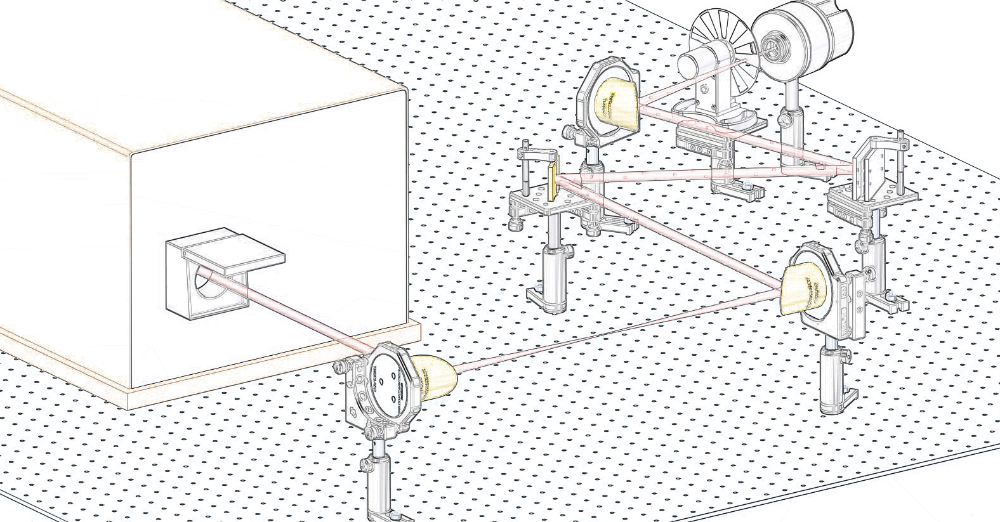
From these two reasons alone, the THz range of electromagnetic spectrum is associated today with two major research directions:
- Space: by observation of chemical composition of the atmosphere and surface of comets, planets, including the Earth, and satellites; probing the molecular chemistry of the universe
- Defense: by identification of hazardous substances of interest, home defense and remote imaging of hidden dangerous objects
The central objective of the project is to develop a THz range Hadamard Transform Image Spectrometer, incorporating, among other components, a digital micromirror device (DMD) hardware and compressive imaging (CI) or compressive sensing/sampling (CS) software technique. Therefore, the project aims to perform research related to:
- spectroscopy of space interest sources in the THz domain (and FIR);
- acquisition and reconstruction of images in the THz domain by CS technique
For this purpose, the following latest methods will be applied during the project:
- Hadamard spectroscopy
- Numerical imaging with spatial multiplexing
- DMD for spatial modulation and software for digital optics
- CS for image recording and compression
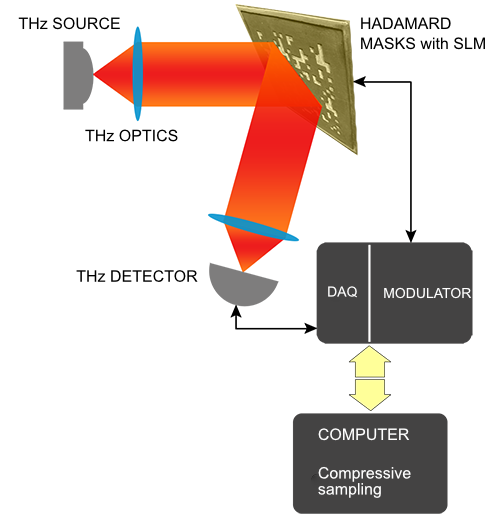
Due to technological advance, it becomes feasible to build, for space applications, a spectrometer with optimized data acquisition, small mass and dimensions, and no moving parts. Our project research will proceed with this trend and will materialize into an experimental model for a Hadamard image spectrometer for THz domain. The principle of the instrument (click the image to enlarge) is as follows: a THz source (which may be collimated or focused, with special THz optics) is incident upon specially designed Hadamard masks. Technically, the masks may be mechanical, DMD or even a Liquid Crystal on Silicon (LCOS). The interaction with the masks (which can be obtained either by transmission or reflection) followed by radiation collimation or focusing (depending on experimental needs), results in the optical computation of multiplexed image projections. The projections are sensed by a THz detector, which converts them into an electrical signal, and finally transmitted to a computer for processing. The masks sequencing is controlled by a Modulator and the projections are acquired by a Data Acquisition module, both controlled by the computer.
Workplan
Phase 1: Concept of THz Image Spectrometer and Simulation of Imaging and Spectroscopy
The objective of this phase is to define the end-to-end model for THz Image Spectrometer and to procure the equipment and components for its experimental model. The team will elaborate an end-to-end model for the THz Image Spectrometer. The main functions of the THz Image Spectrometer – the imaging and the spectroscopy – will be simulated under Matlab, by using synthetic input data. In this phase, it will be analysed, decided and procured the equipments and components for the THz Image spectrometer setup.
Phase 2: Setup of THz Image Spectrometer
The objective of this phase is to elaborate and implement the setup for the THz Image Spectrometer. The equipment and components procured in Phase 1 are characterized in view of integration into the experimental model. The model is implemented and electrically tested. The scheme of the Modulator for the DMD control will be designed. Elaboration of efficient algorithms for Compressive Sensing in accordance with the THz signals statistics.
Phase 3: Functions Development for THz Image Spectrometer
Based on the Matlab simulations in Phase 1 and onto the performances assessment report in Phase 2, the specifications for the instrument functioning in the imaging and spectrometry regimes are defined. The Compressive Imaging and Hadamard spectroscopy modules are designed, implemented and integrated into the software module of the experimental model.
Phase 4: THz Image Spectrometer Validation and Evaluation
Two or three scenarios for ESA applications and 1-2 scenarios for spin-offs will be selected. The experiments conditions will be created and the experiments validated according some procedures. A study for the technical development perspectives will be elaborated.
Info and Links
- Title: Compressive THz imaging and Hadamard spectroscopy for space applications
- Contract: 17/ 19.11.2012
- Duration: 36 months
- Funding: ROSA, Romanian Space Agency
- Partners: INFLPR - Coordinator; CEO Space Tech - Partner
- THz imaging
- compressive sensing
- Hadamard spectroscopy
- THz laser
- digital micromirror device
- Hadamard matrices
- Experimental setup v1
- Experimental setup v2
- Experimental setup v3
- INFLPR
- CEO Space Tech
- SOL group